Organisational overview

ECF staff. ©Photo: Xander Remkes

In 2012, rhetoric against Europe became stronger, even from historically pro-European countries like the Netherlands. Many populist politicians openly discussed leaving the European Union. In addition, the financial crisis became an increasingly harsh reality for many people across the continent. Governments slashed budgets in an attempt to cut public spending and lower national debt. The cultural sector was hit especially hard, often without warning or the opportunity to restructure. The radical budget cuts in the cultural sector in the Netherlands that forced many organisations to merge or even close down made headlines across the Atlantic in The New York Times.

“A coherent, coordinated EU strategy on culture in the EU’s external actions does not currently exist and needs to be developed. It is not a luxury but a necessity to sustain and foster Europe’s attractiveness in a globally connected and competitive environment.”
Marietje Schaake, Member of the European Parliament, Committee on Foreign Affairs and Committee on Culture and Education

ECF is proud to be in a position to counterbalance this  by offering access to international networks and information,  providing some funding for the European non-profit cultural sector, and advocating for the valuable contribution culture has to make to Europe. Also, we are glad to see that cultural funding and engagement of others continued as well, for example through the EU’s Creative Europe programme. As we look to the future, it is clear that the cultural sector needs to team up with other sectors and investigate new models of financing, if it is to be sustainable.

Fortunately, ECF receives 75% of its income from the Prins Bernhard Cultuurfonds (PBCF). ECF has a longstanding agreement with the PBCF and receives 25% of the PBCF’s lottery income. However, there was a decrease in our income from the Prins Bernhard Cultuurfonds in 2012, as a result of declining lottery income due to the economic climate. So far we have been able to weather this and the reduction has been mitigated by increases in other areas, such as investment income. Nevertheless, it is a trend that will continue in 2013. This makes us even more determined to spend our income responsibly, seek synergies and partnerships wherever possible, and go out and fundraise.

In order to be less reliant on one sole source of income, ECF has set the target of realising at least 35% of our income from sources other than the PBCF by 2016.

A new way of working in the networked approach – being more of a catalyst than running all the programmes ourselves – will help us to achieve much more with our financial means. However, the hybrid nature of our work – being both grant-making and operational – requires employment of a number of highly skilled international staff, which resulted in staff costs of 37% of total expenditure in 2012. At the same time, staff benefits have been reviewed and substantial savings have been agreed to reflect market conditions in our sector. We continue to pay close attention to staff costs to ensure a healthy ratio of staff costs against total costs.

Strategy 2012

During our four-year plan from 2009-2012, ECF’s objectives were (and continue to be) to engage and empower people through art and culture; to link cultural policy and practice; and to connect diverse sources of knowledge. In the last year, we focused on increasing our visibility, especially in our host country the Netherlands. We did this for three reasons:

  • Increasing awareness of ECF
  • Emphasising that Europe matters
  • Underlining the contribution that culture makes to Europe.

Achievements

ECF’s two major events in 2012 fitted perfectly into this year’s focus. Our Imagining Europe event, which was held in Amsterdam, was attended by 1,000 visitors and by some 15,000 through online channels. The theme of Europe’s future sparked inspiration, creativity and debates, and generated significant publicity, especially in Dutch media. The event was preceded by the 4th ECF Princess Margriet Award, which was held in Brussels. Laureates John Akomfrah and Charles Esche were keynote speakers at Imagining Europe, thus connecting the two events.

Other events throughout the year also contributed to increasing awareness of ECF and raising our profile in the Netherlands including:

  • A sold-out policy debate organised by ECF and the More Europe consortium at cultural venue Bimhuis in Amsterdam, September 2012
  • Our presence at the Amsterdam-based International Documentary Film Festival Amsterdam IDFA, November 2012
  • Our Remappings book launch at cultural centre De Balie, December 2012.

The Tandem concept first launched in 2011, which fosters exchange and mutual learning between people from EU countries and European neighbouring countries continued to grow with a renewed partnership with the Mercator Stiftung and the Robert Bosch Foundation.

Lessons learned

Strengths: ECF has a good track record and a solid reputation in the cultural sector, as well as with policy-makers. We enjoy strong partnerships, have an extensive network and employ highly skilled international staff. Our financial basis has remained solid despite rigorous cuts in the cultural sector, financial challenges in the philanthropic sector, and the continued economic downturn.

Weaknesses: As ECF actions are based on several pillars, it is difficult to capture our essence in just one key phrase. We divide our time and efforts between many different activities, stretching our resources and making communications challenging. Further, we have not yet been able to fully incorporate impact assessment into our activities to the extent we aimed for by the end of 2012. Realising this is a key objective for 2013.

Opportunities: ECF operates as a catalyst and multiplies the impact of activities. By connecting with other sectors beyond the cultural sector, we can help good ideas to spread even further.

Threats: ECF is largely dependent on one source of income (90% from Prins Bernhard Cultuurfonds in 2011 and 75% in 2012). As the crisis deepens, anti-European and anti-cultural sentiments are growing and the tone of debates and speeches is becoming harsher.

Outlook 2013

Although it was a difficult year in more ways than one, 2012 has provided us with valuable insights for 2013. Now more than ever we are keenly aware of our key values and how important it is to continue to promote them, especially in a climate that is critical towards both Europe and culture. The theme we have chosen for the coming four years is “Culture, creative communities and democracy”.

We will continue to seek partnerships and alliances beyond the cultural sector and expand on and develop the networked way of working that we have begun to adopt. In addition, we will merge our Advocacy and R&D departments to create more synergy in these activity areas.

In 2013 the Board will undertake to look at ECF’s DNA. This in response to the weaknesses mentioned in this report regarding the division of time over many different activities and the difficulties in capturing our essence in just one key phrase.

In 2013 we will start preparations for our 60th anniversary celebrations, which will take place in 2014. All actions will be branded within a future-looking concept and we will scale-up and seek additional profile for ECF’s flagship activities, such as the ECF Princess Margriet Award.

Governance

ECF’s governance structure includes a President, a Board and an Executive Committee. Guidance is provided by an Advisory Council and by small teams of experts who give advice on specific activities. For more detailed information about our governance structure, board members and advisors, please see here.

Expenses

Cost Percentage
Fundraising costs 145,253 2%
Communications 408,745 7%
Securities costs 71,660 1%
Governance 148,417 2%
Operations 308,543 5%
Organisation 1,082,617 18%


Loading

Operations

European Souvenirs Residency, Seville. ©Photo: Ricardo Barquín Molero
“[…] in the end it is about culture, because it is the European spirit at its best.”
Pierre Vimont, Executive Secretary General of the European External Action Service (EEAS)

Finance

Over the past year, ECF’s finance team focused on developing tools to improve the way we manage our expenditure. This included developing and rolling out an automated monthly expenditure report and made improvements to our existing quarterly reports by integrating data from other sources such as our new human resources system so that we can calculate and allocate costs more accurately.

A number of staff changes in the finance team have given us the chance to cast a critical eye over all of our processes, which has resulted in new procedures and more efficient use of our existing financial tools.

During the year, we also worked on a number of donor reports and audits related to external funding, which were all approved by our respective partners and funders.

Human Resources

In 2012, our main focus in HR was on the analysis of ECF’s existing employment conditions for our staff with a view to introducing new working conditions. The HR team and a staff representation group looked carefully at existing conditions and made a proposal for changing to a package of working conditions (including cuts for example in the pension scheme) that better reflects the market conditions in our sector. This proposal was accepted by the ECF Management, Board and staff and the new employment conditions came into effect on 1 January 2013.

We have also updated our staff manual to reflect all of ECF’s current processes and procedures.

“ECF is a small foundation with special attention for the professional and personal development of its staff. Over the past 5 years I have had tremendous opportunities to follow training courses and coaching. These were in line with a professional development plan that was set out with my manager on a six monthly basis. ECF also offers plenty of indirect ‘training opportunities’, such as travel all over Europe and work with inspiring colleagues. In this way, working for ECF not only has stimulated my career progression but has also broadened my understanding of Europe as a whole.”
Dilia Ham, EU Neighbourhood Project Officer

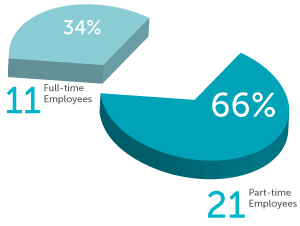
Organisation composition
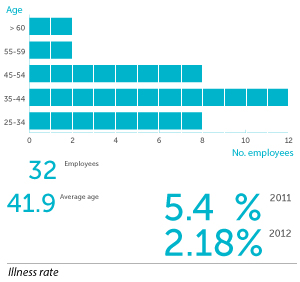
2012 has been a very stable year for ECF as far as employees and the composition of the organisation are concerned. Total turnover of staff was 9.4% (three individuals left the organisation in 2012). This stability is welcome at a time of change, and it makes a big difference to the human resources budget when recruitment costs are low. A tendency to stability is also very much a reflection of the economic climate and lack of vacancies on the labour market.

TimeThe average age of our employees has increased by almost one year to 41.9 years. This is a direct result of the very low turnover. Just over half of our employees have been in service for between one and five years.illness
Nationality
Many of our staff have a multinational/multilingual/multicultural background. In total, 11 languages are spoken at ECF (English, Dutch, French, German, Spanish, Italian, Hungarian, Bulgarian, Polish, Russian and Swedish).

Process Coordination

Our ongoing efforts to standardise contracts and copyright clauses has resulted in the development of new contracts (including new copyright clauses), which were also implemented in January 2013.

Throughout the year, we analysed the use of our IT hardware with a view to making optimum use of our IT systems across the organisation. We started separating and labelling media files so that these can be centrally stored and more easily accessed and used for communications purposes. The digital communications team has also been very involved in the relaunch of our new-look Intranet.

In 2012, we began looking at the feasibility of ECF applying for the CBF keurmerk (a quality mark for fundraising organisations), and we started putting the required processes and procedures in place. In 2013, we intend to apply for the quality mark.

Reception & Facility Management

In 2012, our reception and facility management team played an important role in supporting ECF in the organisation of various high-profile events (including the ECF Princess Margriet Award and Imagining Europe), as well as other communications initiatives. Additionally, this department was involved in analysing the relationships ECF has with various providers of services such as stationery and telecommunications. This last activity has lead to a reduction in costs.

Outlook 2013

Finance
In 2013, the finance team will continue to focus on integrating support for funding applications and donor reports into our existing portfolio. We are developing the skills to deal with the rigorous demands of funding applications and donor reporting, which involve the preparation of extensive financial information and documentation.

The scheduled implementation of a government-required system referred to as the ‘werkkosten regeling’ – a new system for allocating staff-related costs – will lead to a further professionalisation of our processes.

Human Resources
Given the implementation of a new four-year Strategic Plan, 2013 will be a year of transition for ECF and the HR team will focus on supporting this transition. We will turn our attention to organisational and staff development: revising job profiles; lending support in changing the organisational structure; and, most importantly, ensuring that staff whose roles are changing have the appropriate opportunities to build the skills needed for their new roles.

With this in mind, we will continue to ensure that ECF has the appropriate HR tools in place, and to monitor the quality and ‘fit’ of the external services we engage for our work.

Process coordination
In 2013, ECF intends to apply for the CBF quality mark for fundraising organisations (see above).

We will also continue to initiate and support processes that enhance the digitalisation of the organisation. A few examples of this include: increase the use of social media in ECF and transfer all media files to a dedicated media server.


Loading

Communications and Fund Development

Imagining Europe at Stadsschouwburg Amsterdam. ©Photo: Jan Boeve

During 2012, ECF was able to raise our profile on a local and European scale. We enjoyed increased press coverage – especially in the Netherlands, where we have been relatively unknown. A media analysis of our Imagining Europe event allowed us to see not only the volume of coverage but also the impact of our messages. We were also able to engage with a growing number of followers via social media such as Twitter and Facebook. Consistent online and offline branding has helped to create a more coherent and distinctive identity for ECF and our activities.

All team members bring individual expertise that complements the skills of other team members. Grants, Programmes and Advocacy have a dedicated contact within the Comms/Digital team. Depending on the target group, any combined programme team can involve other areas of expertise to increase the effectiveness of communications. The communications budget is divided over all ECF activities.

Events

During 2012, we organised a number of high-profile events. Events are a key public advocacy tool that support our goals, meet our communications objectives and also create networking opportunities with existing and potential partners. Some events are recurring (for example, the ECF Princess Margriet Awards and IDFA activities). Others were organised last year to commemorate milestones in our programmes (such as Imagining Europe). In both instances, ECF has been striving to broaden the appeal of events to reach a wide audience and to create synergy with other ECF activities, and so to increase the impact of our work.

In 2013, preparations will start for ECF’s 60th anniversary celebrations (2014) and a major European event, the European Foundation Centre’s Annual General Assembly (2015).

Press/PR/Campaigns/Marketing

In order to make sure that ECF’s message reaches the right target groups, we have built an extensive network of press and PR contacts throughout Europe. Major events like the ECF Princess Margriet Award and Imagining Europe provided excellent opportunities for expanding and enhancing our media contacts in 2012.

ECF works together with partners within the cultural sector and beyond, supporting campaigns such as we are more and More Europe, which highlight the connecting role of arts and culture in society. Our involvement with these networks also increases the visibility of ECF and our activities across international platforms.

In the run up to the Princess Margriet Award, the More Europe debate and Imagining Europe we used both Facebook and Twitter to broaden and connect with our audiences – either online or at the event. At the More Europe debate and Imagining Europe event we took advantage of our strong social media channels, highlighting key ECF messages and content. We saw user engagement increase beyond “average” levels, and there was a huge increase in local online audiences.

As well as sending out the monthly ECF e-zine with news, events and updates, we sent out 10 special e-zine editions dedicated to a special subject. With around 10,000 recipients and an average open rate of 30%, the e-zines are received well. (E-zine overview 2012)

We will continue to focus on building and strengthening our networks in 2013, with particular emphasis on developing multilingual press materials and increasing use of social media.

Digital

The digital team helps ECF to reach and engage with target groups using online platforms. It provides the tools and strategy for supporting digital communities and actively shares digital culture within the organisation, through training sessions and through the Intranet.

During the past year, much work has gone into reinforcing ECF’s online branding. For instance, we changed our web address to www.culturalfoundation.eu, which is much more relevant than the previous address. We also focused on creating new ways to access ECF’s online platforms, using mobile devices like smartphones and tablets.

The digital team will continue these activities in 2013, as well as working with colleagues in the Communications team to focus on recruiting and broadening ECF’s online audience.

Social media and online presence

ECF carried out a social media review in 2012. We looked at our existing social media platforms and reviewed which tools were working well for us, and how we would like to work with these tools going forward.

We improved our content on these platforms as a result – creating a strong reputation for excellent content and a broadening our online audience. We can measure this by continued engagement, as well as repeat visits, to all our online platforms.

We decided to invest our energies on the most successful and useful platforms for our work: Facebook (focusing on dedicated users), Twitter (retweeting valuable content), Vimeo (sharing do-it-yourself documentaries) and in particular Youtube: We used YouTube to host our growing collection of videos and films. In 2012, we commissioned a new wave of interview-style film clips and programme-related videos, which attracted increased viewers. In total, we had more than 12,500 views of our videos over the past year.

We also created social media guidelines for ECF staff in order to maximise our potential in this area. We hope this will significantly increase our messaging reach among cultural thought leaders in 2013.

Publications

ECF has always been a publisher – stand-alone as well as in partnerships – as it is a means of reaching out and sharing content. Lately, we have increasingly combined offline and online publishing, to support our programme-based content and our corporate activities and events. Read more about our publications activities here.

Fund development

ECF’s income derives from three main sources:

  • Funding from the Lotto and BankGiroLoterij through a long-term partnership agreement with the Prins Bernhard Cultuurfonds which stipulates that 25% of PBCF’s lottery income is earmarked for ECF
  • Support from foundations, companies and governments for specific activities
  • Return on investment.

ECF’s long-term objective for fundraising is to diversify its income so that we are less vulnerable to possible fluctuations in a particular funding source (like, for example, in relation to our return on investments, which is unpredictable despite the low risk profile of our investment portfolio.)

ECF has continued to cooperate with a number of known foundations and new contacts have been established with both foundations and companies, following our focus on building stronger relations with partners in the Netherlands, especially around the Imagining Europe event.

ECF has received a two-year grant from the European Commission ‘Culture’ Programme for a project of the Youth & Media Programme, and, after a succesful tender, is taking part in a consortium, led by the Goethe Institut, for carrying out the Preparatory Action “Culture in External Relations” for the European Commission.

As a result of all our efforts, we achieved our fundraising target of €773,000 third party and government income in 2012. In 2013, we will continue to build on this successful base.

Outlook for 2013

In 2013 ECF Communications will build on the learning of last year, and further expand our visibility in the Netherlands and abroad as well as online.

The communications strategy and all our communications-related activities will continuously focus on:

  • Introducing ECF to a range of audiences across Europe and in the Netherlands
  • Improving ECF’s brand recognition
  • Building long-lasting relationships to promote understanding of our work
  • Communicating our mission and vision and in particular our new way of working – the networked approach.


Loading